Serve 42 African Markets From One Cloud Account
Published: · 6 min read · By Oluniyi D. Ajao
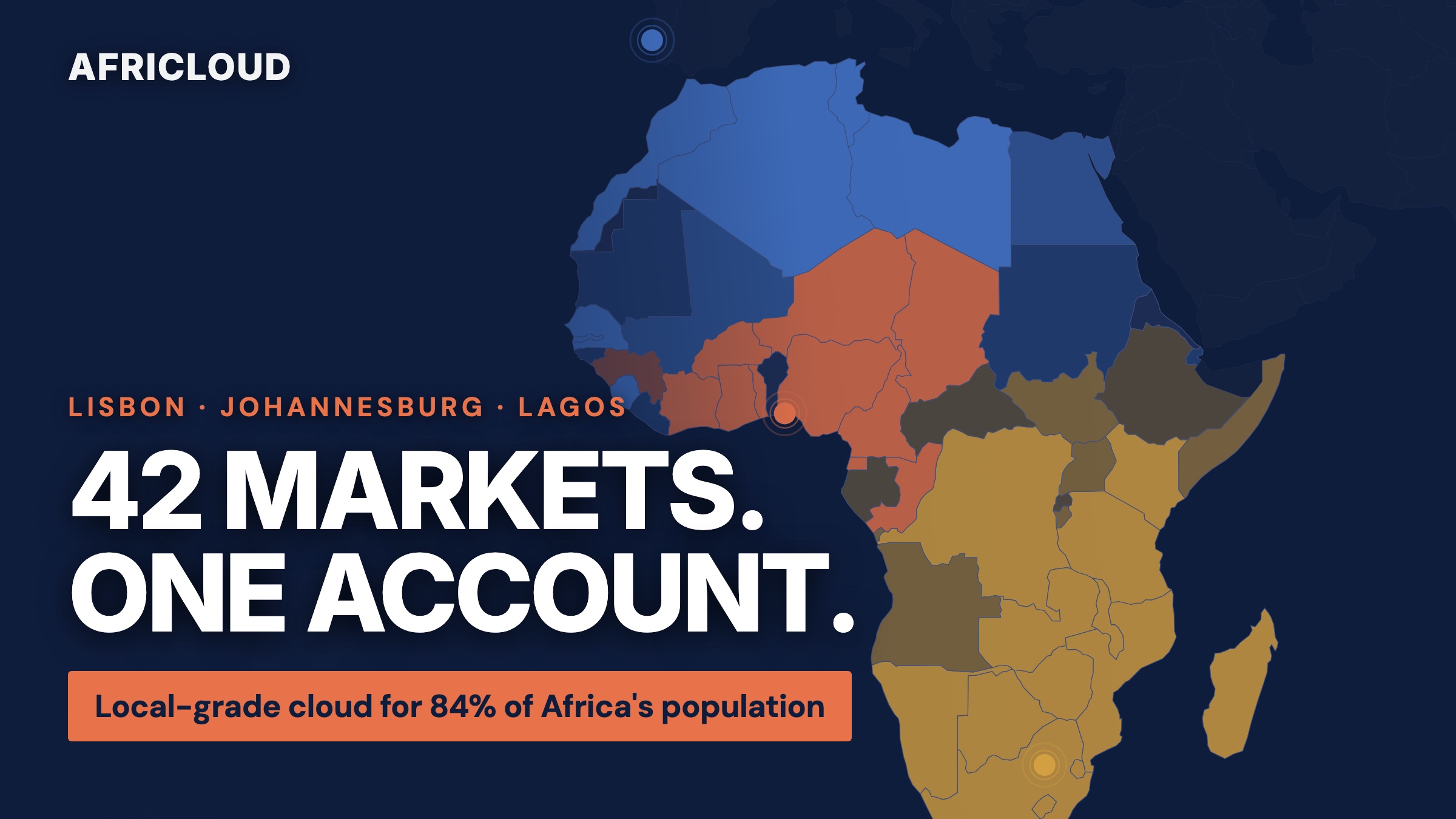
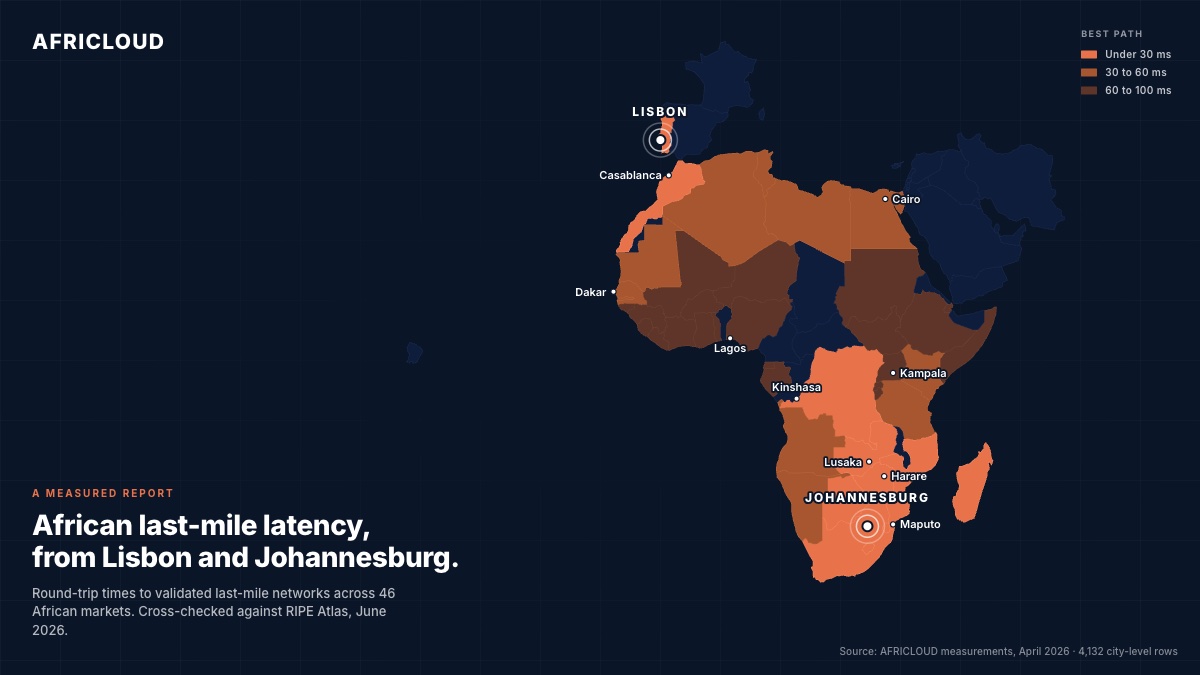
Measured in August 2026, 42 of the 53 African countries we test can be reached at a best-case round trip of under 70 milliseconds from at least one AFRICLOUD region. Those 42 countries are home to roughly 1.28 billion people, just over 84% of Africa's population (World Bank, 2024). In practical terms: one account, three regions, and an addressable map that covers more than four in five Africans at the kind of responsiveness their local providers deliver.
This is not an article about milliseconds. It is about what those milliseconds buy: the ability to enter, serve and win markets across Africa without building infrastructure in each one.
What does "local-grade" actually mean for a business?
A long-standing usability rule of thumb, popularised by the Nielsen Norman Group, puts the threshold at which an interface "feels instant" at about 100 milliseconds. That budget has to cover everything: the network round trip, encryption, the server doing its work, and the screen updating.
A network round trip under 70 milliseconds leaves real headroom inside that budget. It is the difference between a checkout that responds as the customer taps and one that visibly hesitates. Between a dashboard that feels native and one that feels hosted abroad. For payment APIs, point-of-sale systems, collaborative tools, live marketplaces and anything with a human waiting on the other end, it is the line between "this works here" and "this was built for somewhere else".
When that line moves, the market map moves with it. An application hosted with AFRICLOUD is inside that budget for customers in 42 African countries, without the operator doing anything except choosing the right region at deployment.
Which markets, from which region?
The three regions divide the continent between them, and the coverage zones are drawn from our own continent-wide round-trip measurements across thousands of network vantage points, not from marketing assumptions.

Johannesburg carries Southern and East Africa: South Africa in-country, and the corridor running up through Botswana, Zimbabwe, Zambia, Malawi, Mozambique, Tanzania, Kenya and Uganda, with the Indian Ocean economies of Mauritius, the Comoros and Madagascar alongside.
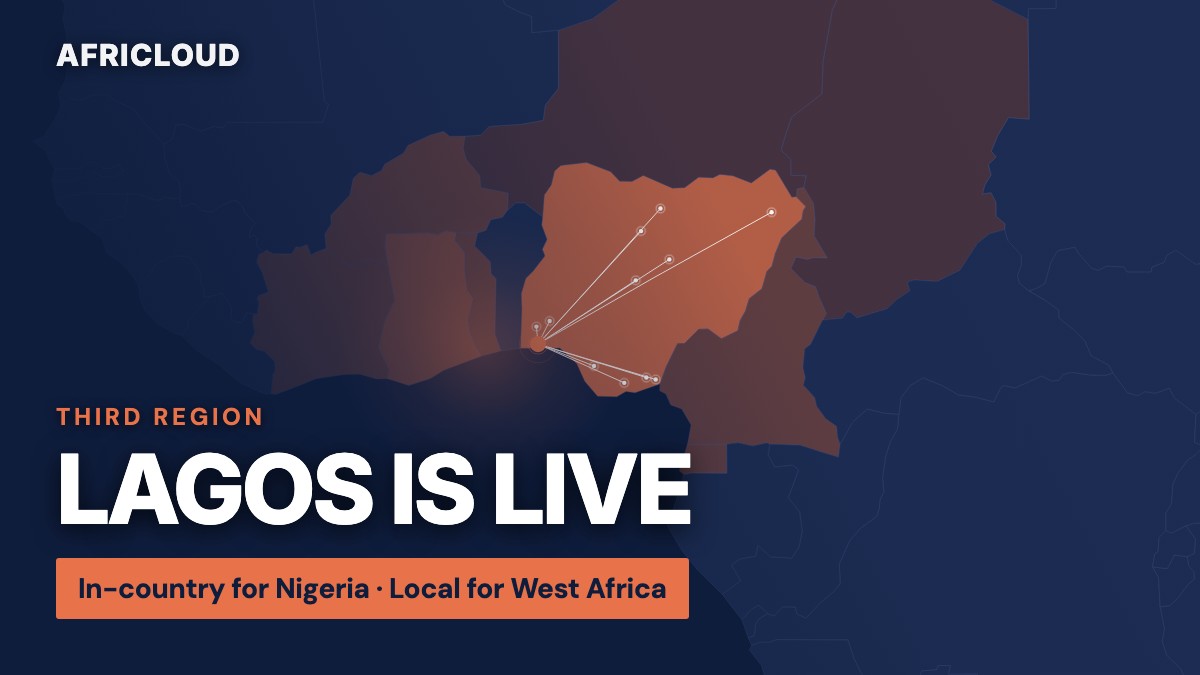
Lagos carries Nigeria in-country and much of West and Central Africa: Ghana, Côte d'Ivoire, Togo, Cameroon and their neighbours, measured from our new Lagos facility. It also brings the landlocked Sahel, including Burkina Faso, Niger and Chad, within reach over terrestrial West African fibre, where reaching comparable infrastructure previously meant a detour through Europe. Our Lagos region announcement covers the Nigerian side in detail.
Lisbon carries North Africa, from Morocco through Algeria, Tunisia, Libya and Egypt, together with parts of the West African coast, and pairs the African map with Europe and with Brazil over a direct subsea route between Portugal and South America.
The figures behind the map are best-case minimums, measured the way we publish all our numbers: real-world latency may be 10 to 30% higher depending on carrier and path, and anyone can verify from their own network at lg.africloud.com. The full measurement story is in our African last-mile latency report.
Why does the network reach this far?
Coverage claims are easy to make and expensive to fake, so here is the mechanism, and it is publicly checkable.
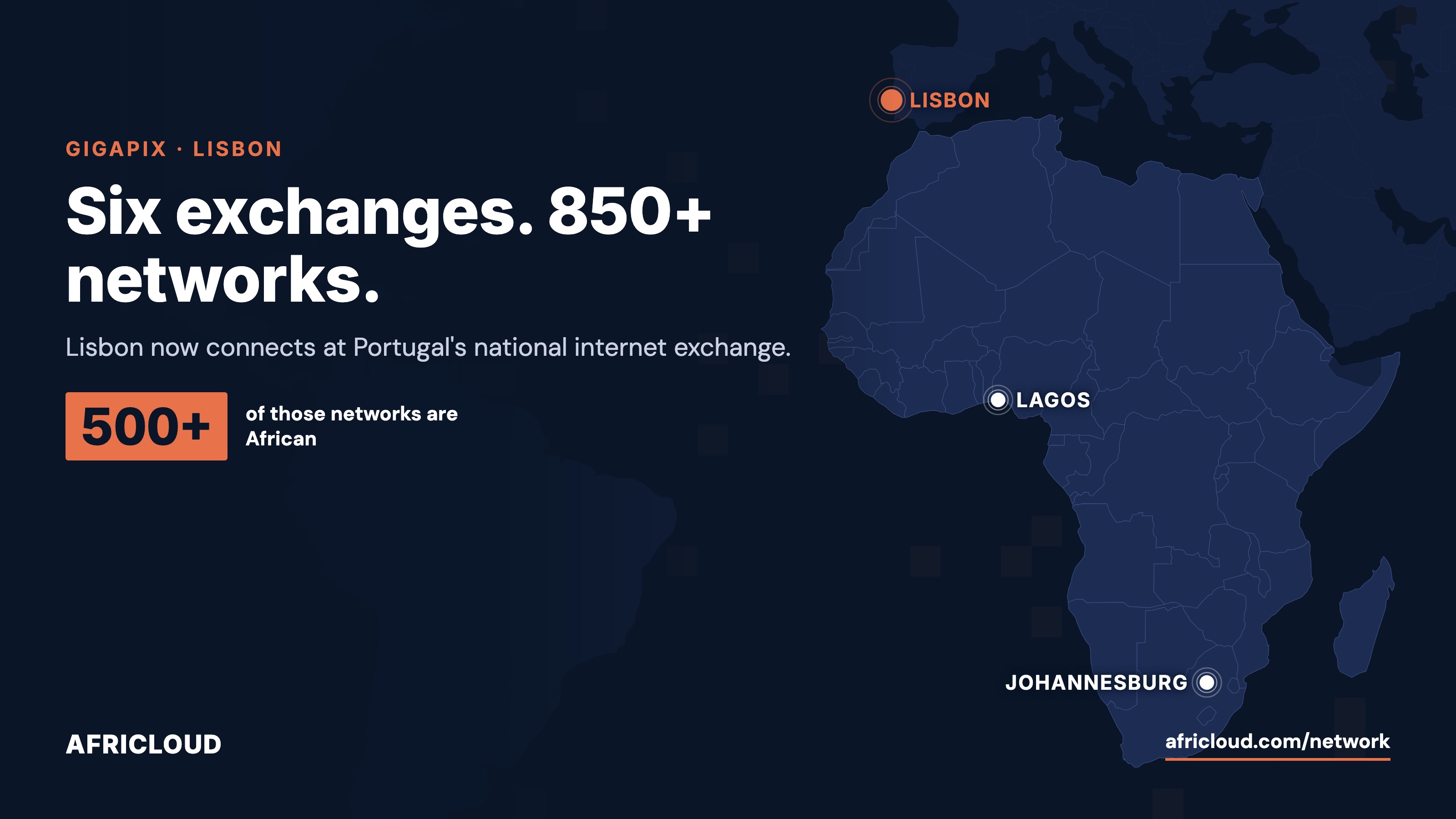
AFRICLOUD exchanges traffic directly with more than 700 networks at four internet exchanges: NAPAfrica in Johannesburg, the Internet Exchange Point of Nigeria in Lagos, and DE-CIX in both Lisbon and Madrid. More than 500 of those networks are African, spread across 33 African countries. That is the unusual part. Most clouds serving Africa peer heavily in Frankfurt, Amsterdam or London and reach African users over long transit paths. Our adjacency graph points the other way: the majority of the networks we touch directly are the continent's own mobile operators, ISPs, carriers and cable systems, alongside the global content platforms and Tier-1 backbones that round out the mix.
Direct adjacency is what makes the coverage real. When the network your customer is standing on is one hop away at an exchange, their traffic does not board a plane to Europe and back. Every part of this is independently verifiable: our network is AS209179, and services such as bgp.tools and PeeringDB show the peering graph to anyone who cares to look.
The same seriousness applies to how the network is run. Route origins are validated with RPKI and invalid routes are rejected on all sessions. Routing intent is registered in the RIPE and AFRINIC databases. Anti-spoofing filtering follows BCP38, with a full pass on CAIDA's independent Spoofer test. We implement all four MANRS actions, and every server ships with native IPv4 and IPv6. None of this appears on a pricing page, but it is the difference between a network that happens to work and one that is built to keep working.
What do you actually deploy into those markets?
The same platform runs in all three regions. Cloud servers are built on AMD EPYC processors with enterprise NVMe storage on every plan, full root access, a choice of Linux images with one-click reinstall, and enforced per-plan port speeds that are real rate limits, not brochure numbers. Included transfer runs from 1 TB to 8 TB depending on plan, and it is a soft cap: beyond it, network speed is reduced for the rest of the billing period, with no hard block and no overage charges. A new server is deployed and online in about two minutes, and dedicated servers are ordered and provisioned the same self-service way.
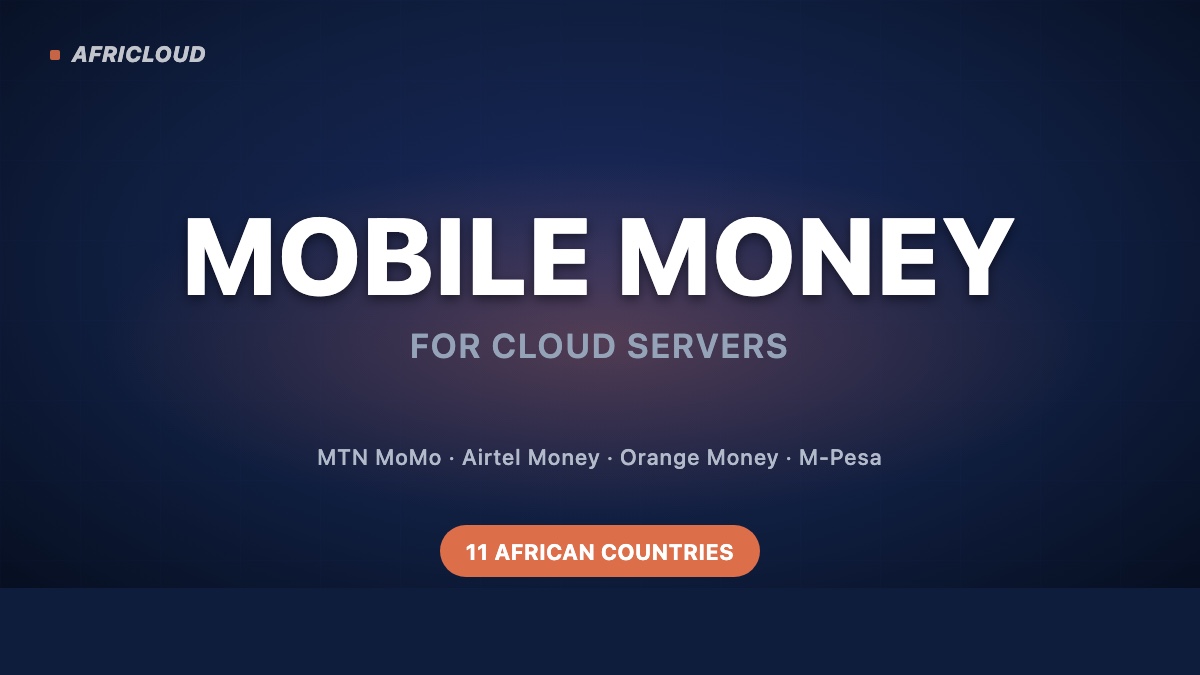
The platform around the server is built for teams that automate. A public REST API, documented openly at africloud.com/docs and compatible with Terraform and Ansible, drives everything from deployment to floating IPs, with scoped, IP-restricted API keys. On-demand snapshots and automated daily backups cover recovery; block-storage volumes grow online without downtime; a platform-level firewall sits beneath the guest OS; and private networking between your servers is genuinely unmetered. Billing flexes to how you operate: hourly pay-as-you-go or monthly, a prepaid wallet, and checkout in your own currency by card, PayPal, more than 300 cryptocurrencies or, in twelve African markets, mobile money.
What does this mean if you are choosing where to host?
Three regions on one account also means three jurisdictions on one account. Nigerian data can stay in Lagos on Nigerian soil, which matters to anyone working within the NDPA, as our data residency explainer sets out. South African workloads sit in Johannesburg under POPIA. European workloads sit in Lisbon under EU law. Compliance postures differ and specific requirements always call for an individual legal assessment, but the structural question of where the data lives is answered by a dropdown at deployment, not by a migration project.
For a business planning growth, the practical reading of the map is this: the 42 countries inside the 70-millisecond line are markets you can serve credibly today, from infrastructure that already exists, with local-grade responsiveness and no capital outlay. Pick the region closest to your customers, deploy, and the coverage comes with the account.
Explore the network in detail at africloud.com/network, or deploy a server in Lisbon, Johannesburg or Lagos in minutes.