AFRICLOUD Opens Lagos Region: In-Country Cloud for Nigeria
Published: · 5 min read · By Oluniyi D. Ajao
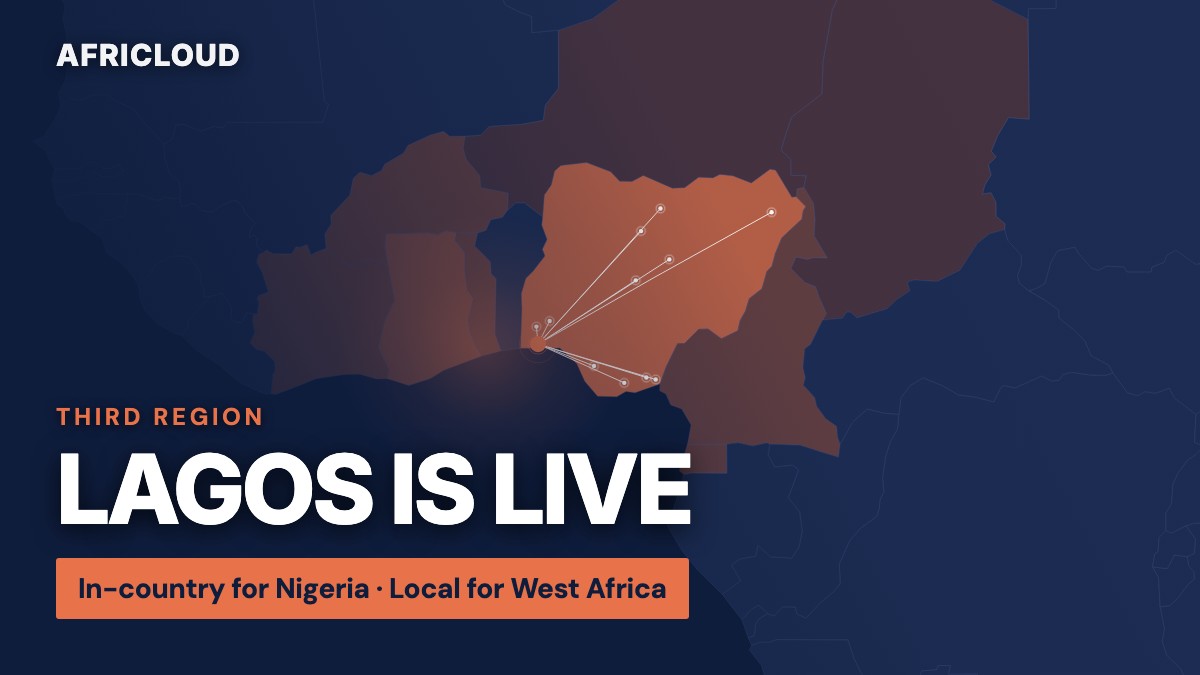
AFRICLOUD, the cloud infrastructure provider operating from Lisbon and Johannesburg, has opened its third region in Lagos, Nigeria. Cloud servers now deploy inside Nigeria, from a carrier-neutral data centre in the heart of Lagos, and orders are open to everyone through the dashboard. For Nigerian businesses, startups and public-sector teams, this means compute and storage that live on Nigerian soil rather than in Europe or South Africa.
What is the AFRICLOUD Lagos region?
The Lagos region is a full compute location alongside our Lisbon and Johannesburg regions: the same account, the same dashboard, the same payment options, with servers physically hosted in Lagos.
The region operates from a carrier-neutral data centre in Lagos's central business district, with 2N power and N+1 cooling as published by the facility operator. Servers run on enterprise AMD EPYC compute with all-NVMe storage, and every cloud server includes both IPv4 and IPv6 connectivity. Provisioning is automated end to end: a new server is deployed and reachable in minutes after checkout.
Why does in-country hosting matter for Nigerian businesses?
Nigeria is Africa's largest internet market, and until now most Nigerian workloads have been hosted abroad by necessity, in European, South African or American facilities.
Hosting in the Lagos region means your data stays on Nigerian soil. That is directly relevant to organisations working within the Nigeria Data Protection Act (NDPA) and to any team whose customers, regulators or procurement policies ask where the data actually lives. As with any regulation, specific compliance requirements call for an individual legal assessment, but the underlying question "is the data in Nigeria?" now has a straightforward answer. Our explainer on what Nigeria's data rules require, and what they do not looks at the NDPA in detail.
It also removes the structural distance penalty. An application served from Europe is a long round trip from its Nigerian users on every single request. An application served from Lagos is next door.
How fast is it inside Nigeria?
Measured round-trip times from the Lagos region to Nigerian cities:
| City | Round-trip time |
|---|---|
| Lagos | 0.2 ms |
| Ikeja | 0.4 ms |
| Ibadan | 1.8 ms |
| Abeokuta | 2.2 ms |
| Port Harcourt | ~6 ms |
| Abuja | ~10 ms |
| Uyo | ~11 ms |
| Maiduguri | ~12 ms |
| Warri | ~13 ms |
| Zaria | ~13 ms |
| Jos | ~17 ms |
| Kano | 17 ms |
| Calabar | ~22 ms |
These are measured samples, not a coverage list: the region serves the whole country. Values marked with a tilde come from smaller measurement samples. Single-digit to low-double-digit milliseconds from Lagos to every corner of the country is the practical difference between an application that feels local and one that feels hosted abroad. The figures come from the same measurement approach as our measured report on African last-mile latency.
What does the Lagos region mean for the rest of West and Central Africa?
Lagos is not only Nigeria's local cloud region. Measured from our new Lagos facility, round-trip times reach Accra in about 7 ms, Ouagadougou in about 12 ms, Malabo in about 15 ms, Abidjan and Yamoussoukro in 16 to 17 ms, Douala and Yaoundé in 19 to 20 ms, and Lomé in about 21 ms. For businesses in Ghana, Burkina Faso, Equatorial Guinea, Côte d'Ivoire, Cameroon and Togo, Lagos is now by far the closest AFRICLOUD region.
The quiet story is the Sahel. Landlocked Burkina Faso, Niger and Chad now reach Lagos over terrestrial West African fibre, with Ouagadougou at roughly 12 ms, Bobo-Dioulasso at 28, Niamey at 32 and N'Djamena at 42. Until now, these markets could only reach our infrastructure through Europe, at 100 ms or more. For teams building in Ouagadougou, Niamey or N'Djamena, Lagos is the first cloud region that feels local rather than intercontinental.
How do the three regions fit together?
Every AFRICLOUD account can deploy in any region:
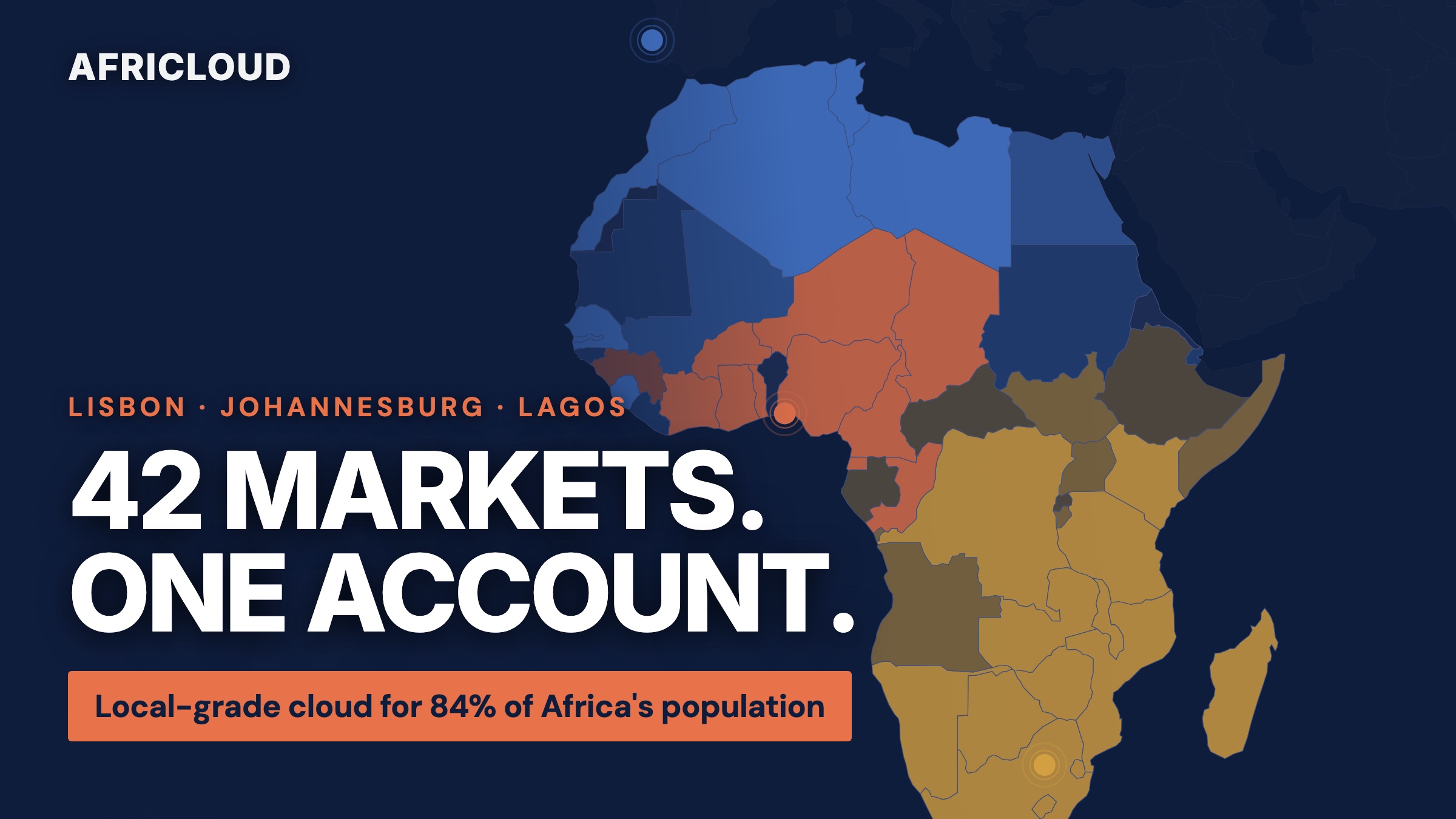
- Lisbon, Portugal: European Union jurisdiction, serving Europe, North Africa and South America.
- Johannesburg, South Africa: in-country for South Africa under POPIA, serving Southern and East Africa.
- Lagos, Nigeria: in-country for Nigeria, relevant to the NDPA.
Three regions means three jurisdictions to choose from. Teams can keep Nigerian data in Lagos, serve European customers from Lisbon, and run Southern African workloads from Johannesburg, all on one account. For a closer look at choosing between regions, see Lisbon vs Johannesburg: Lagos now joins that choice.
Who is the Lagos region for?
Startups and developers. Everything is self-service. Create a server from the dashboard, get full root access, and reinstall or rebuild in a click when an experiment goes sideways. Block storage, backups and floating IPs are there as the architecture grows, and what the dashboard does, the API can do too. Pay by card, PayPal or cryptocurrency, and scale when the product does.
Enterprises. Beyond self-service cloud servers, dedicated servers provision automatically in the same dashboard, and advanced networking is available up to announcing your own IP space over BGP. Teams with fleet, compliance or SLA requirements can engage us for managed private cloud on dedicated hardware, with the standard enterprise paperwork: NDA, master services agreement, data processing agreement, and a named engineer on the account.
Government and public-sector teams. For ministries, agencies and parastatals, the Lagos region means departmental and citizen-facing workloads hosted on Nigerian soil, with commercial terms that fit public procurement: purchase orders, invoicing on agreed terms, and multi-year agreements. Where requirements go beyond self-service, engagements start with a scoping call and a written architecture proposal.
How do I get started?
Cloud servers in the Lagos region are available now on the Nigeria page and directly at the order page. Payment is by card, PayPal or more than 300 cryptocurrencies. Servers deploy in minutes with full root access, and the Lagos region page carries the region detail.
Nigeria has waited a long time for cloud infrastructure that lives where its users live. It is live now.