Lisbon to Fortaleza: 73ms VPS Latency via Direct Routing
Published: · Updated: · 8 min read · By Oluniyi D. Ajao
For businesses and individuals requiring low-latency connectivity between Europe and Brazil, server location matters enormously. Traditional routing often sends traffic from Europe through North American networks before reaching South America, adding unnecessary milliseconds to every request. However, direct submarine cable infrastructure connecting Portugal to Brazil's northeast coast offers a compelling alternative, with real-world latency as low as 73 milliseconds from a strategically located VPS provider.

AFRICLOUD conducted comprehensive network testing from our Lisbon data centre to 29 cities across Brazil, analysing 132 MTR traces to map actual performance. The results demonstrate that Lisbon-based virtual private servers can achieve excellent connectivity to Brazil, particularly for the country's northeastern region.
The Direct Route Advantage
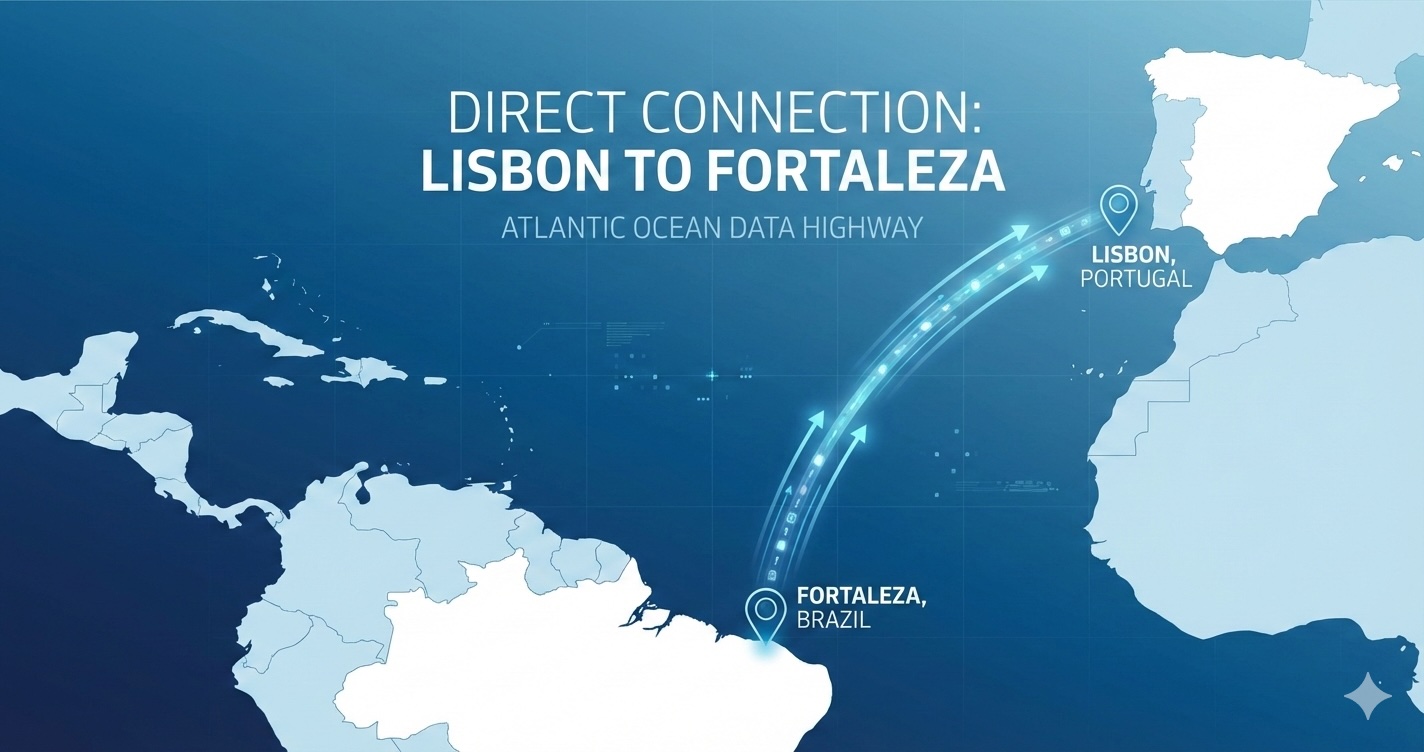
When traffic flows directly from Lisbon to Brazil via submarine cables landing at Fortaleza, packets travel approximately 5,500 kilometres across the Atlantic. Compare this to the traditional US transit route: Lisbon to Madrid, London, New York, then Miami before finally reaching Brazil, covering nearly twice the distance and crossing the Atlantic twice.
Our testing confirmed this difference quantitatively. In our January 2026 survey, direct-routed connections to Brazil's northeast averaged 118ms latency, whilst US-transit connections averaged 218ms, representing a 46% improvement when using the direct path. For latency-sensitive applications, this difference is substantial. As we explored in our analysis of why server proximity matters for business applications, even modest latency reductions compound into meaningful user experience improvements.
Latency Performance by Brazilian City
We categorised the 29 tested cities into performance tiers based on best-case round-trip times from our April 2026 re-measurement (4,288 validated endpoints; see methodology):
Tier A: Excellent (Below 100ms)
Eight Brazilian cities achieved sub-100ms best-case latency from Lisbon in the April 2026 re-measurement:
- Fortaleza (CE): 73ms - the primary submarine cable landing point
- João Pessoa (PB): 84ms
- São Luís (MA): 85ms
- Natal (RN): 86ms
- Recife (PE): 86ms
- Teresina (PI): 88ms
- Belém (PA): 92ms
- Aracaju (SE): 92ms
Seven of the eight are in Brazil's Northeast, benefiting from proximity to the submarine cable landing infrastructure; Belém, in the North, also clears the 100ms mark.
Tier B: Good (100-150ms)
Seventeen cities fell within the 100-150ms range, suitable for most interactive applications:
- São Paulo (SP): 107ms - Southeast (Brazil's largest city)
- Maceió (AL): 107ms - Northeast
- Guarulhos (SP): 107ms - Southeast
- Belo Horizonte (MG): 108ms - Southeast
- Palmas (TO): 109ms - North (smaller sample)
- Macapá (AP): 109ms - North
- Vitória (ES): 110ms - Southeast
- Salvador (BA): 111ms - Northeast
- Goiânia (GO): 117ms - Central-West
- Brasília (DF): 119ms - the federal capital
- Rio de Janeiro (RJ): 120ms - Southeast
- Campinas (SP): 130ms - Southeast
- Porto Alegre (RS): 135ms - South
- Cuiabá (MT): 138ms - Central-West
- Curitiba (PR): 140ms - South
- Manaus (AM): 143ms - North (Amazon region)
- Florianópolis (SC): 144ms - South
Tier C: Acceptable (150-200ms)
Four cities showed best-case latencies between 150-200ms:
- Campo Grande (MS): 158ms - Central-West
- Porto Velho (RO): 168ms - North
- Rio Branco (AC): 174ms - North (Amazon region)
- Boa Vista (RR): 178ms - North (smaller sample)
Tier D: Challenging (Above 200ms)
None. In our January 2026 survey two cities exceeded 200ms; by April 2026 improved routing had brought every tested city below 180ms best-case. January's outlier, Curitiba, whose 237ms we attributed to routing inefficiency rather than distance, confirmed that diagnosis by dropping to 140ms.
Regional Performance Summary
Averaging each region's best-case city latencies (April 2026) reveals clear patterns:
- Northeast: 91ms average - best overall connectivity
- Southeast: 114ms average - includes São Paulo and Rio de Janeiro
- Central-West: 134ms average
- North: 139ms average - Amazon region challenges
- South: 140ms average - furthest from cable landing points
The Northeast region's superior performance stems from its proximity to Fortaleza, where transatlantic cables make landfall. Traffic destined for southeastern cities like São Paulo often travels north to Fortaleza first, then south via Brazil's domestic backbone; the April re-measurement shows the Southeast and South closing the gap as that domestic routing has matured.
How the Lisbon Route Compares in 2026
Three realistic options exist for serving Brazilian users, and the honest answer depends on where the rest of your audience is:
- In-country hosting (São Paulo): the lowest possible latency for users inside Brazil. If your entire audience is Brazilian and local billing suits you, in-country hosting wins on raw numbers.
- US-East deployment: the common default, typically adding 110-180ms round-trip to Brazilian metros, often with bandwidth-egress pricing on top.
- Lisbon direct Atlantic route: 73ms to Fortaleza, 107ms to São Paulo and 120ms to Rio de Janeiro measured in April 2026, with the same server reaching London and Paris in under 30ms. One deployment serves Brazil and Europe simultaneously, on flat pricing, paid by Pix, card, PayPal or 300+ cryptocurrencies.
For a Brazil-only audience, local hosting remains the latency benchmark. For a business serving Brazil alongside Europe or Africa, or one that prefers Pix or crypto billing over local invoicing, the Lisbon route is the strongest option on the table. Plans and payment details are on our Brazil page.
Business Applications
These latency figures translate into tangible benefits across multiple use cases:
Software as a Service (SaaS)
European SaaS providers expanding into Brazilian markets can serve customers from Lisbon infrastructure whilst maintaining responsive user experiences. With sub-150ms latency to Brazil's major economic centres, web applications remain snappy and API responses feel immediate. Conversely, Brazilian SaaS companies can use Lisbon servers to serve European customers whilst maintaining acceptable performance for their home market. This approach mirrors how African startups leverage strategically positioned VPS infrastructure to reach global markets.
Financial Technology
Fintech applications processing cross-border transactions between Europe and Brazil benefit from reduced round-trip times. Payment confirmations, real-time balance updates, and trading platforms all perform better with lower latency. The 73-120ms achievable to major Brazilian financial centres compares favourably with alternatives.
Gaming and Real-Time Applications
Multiplayer gaming servers, voice communication platforms, and collaborative tools require consistent low latency. Whilst competitive gaming typically demands sub-50ms, many game genres and real-time applications function well at 100-150ms. Brazilian players connecting to Lisbon-hosted game servers experience noticeably better performance than connecting to US-based alternatives.
E-Commerce Platforms
Online retail depends heavily on page load speed for conversion rates. Studies consistently show that each 100ms of added latency reduces conversion by measurable percentages. European e-commerce businesses targeting Brazilian consumers can improve their competitiveness by hosting in Lisbon rather than more distant locations. Pairing low latency with NVMe storage delivers the performance that modern e-commerce platforms demand.
Content Delivery and Media
Video streaming, content management systems, and media distribution platforms benefit from reduced initial connection times. Whilst cached content typically uses edge networks, origin servers in Lisbon provide faster cache population and better performance for dynamic content serving Brazilian audiences.
Private VPN and Remote Access
Individuals and businesses requiring secure connections between Europe and Brazil find Lisbon-based VPN servers attractive. Remote workers, travellers needing secure access to home resources, and privacy-conscious users benefit from the direct routing. A VPN endpoint in Lisbon offers Brazilian users a European presence with significantly lower latency than alternatives hosted further from submarine cable routes.
Development and Testing
Software development teams distributed between Europe and Brazil can use Lisbon-based development servers, staging environments, and CI/CD infrastructure. The lower latency makes remote pair programming, live code reviews, and collaborative debugging more practical.
Who Benefits Most
Two primary audiences gain the most from Lisbon's positioning:
European businesses expanding to Brazil: Rather than establishing separate Brazilian infrastructure immediately, companies can serve the Brazilian market from Lisbon whilst testing product-market fit. The Northeast region, with cities like Fortaleza, Recife, and Salvador totalling over 15 million people, receives excellent connectivity.
Brazilian users seeking European presence: Whether for accessing European services, establishing a European digital footprint, or serving European customers, Brazilian individuals and businesses can use Lisbon servers knowing their home country remains accessible with reasonable latency.
Technical Considerations
Several factors influence actual performance:
ISP routing: End-user latency depends partly on how Brazilian ISPs route traffic. Some providers peer directly with European networks; others route through US intermediaries regardless of destination.
Time of day: Network congestion varies throughout the day. Our tests captured best-case figures; peak hours may show higher latencies.
Application protocol: TCP-based applications incur additional round trips for connection establishment. UDP-based applications like VoIP or gaming may achieve lower effective latencies.
Content optimisation: Techniques like connection pooling, HTTP/2 multiplexing, and aggressive caching can mitigate latency impact for web applications.
Methodology
Two measurement campaigns inform this article. Our January 2026 survey used MTR (My Traceroute) to run 132 traces across 29 Brazilian cities. In April 2026 we re-measured at far larger scale, recording round-trip times from AFRICLOUD's Lisbon infrastructure to 4,288 validated endpoints across the same 29 cities, spanning diverse ISPs and hosting providers. Per-city figures on this page report the best-case (minimum) RTT from the April dataset; per-endpoint averages vary widely with last-mile congestion. You can verify any figure from your own connection using our Looking Glass.
Conclusion
Lisbon's strategic position at the European terminus of direct submarine cables to Brazil creates genuine advantages for latency-sensitive applications. With 73ms achievable to Fortaleza and sub-150ms to most major Brazilian cities, VPS hosting in Portugal offers a compelling option for cross-Atlantic connectivity.
For workloads requiring the lowest possible latency to Brazil's Northeast or acceptable performance nationwide, Lisbon-based infrastructure deserves serious consideration. The data confirms what geography suggests: sometimes the shortest path across an ocean beats the longest path around it.
Run your own latency tests using our Network Looking Glass to verify connectivity to your specific Brazilian targets. Ready to deploy? Explore AFRICLOUD's Lisbon VPS plans and experience the direct route advantage for yourself.
Related: VPS for African startups, self-managed VPS guide, network testing with Looking Glass, NVMe storage for e-commerce, pay with Bitcoin.