AWS Alternatives for Nigerian Businesses: How to Choose
Published: · Updated: · 7 min read · By Oluniyi D. Ajao

If you run a business in Nigeria on AWS, the question worth asking is not whether to leave. It is which parts of your stack are in the wrong place. Most Nigerian companies that move end up splitting: some workloads stay on a hyperscaler because nothing else runs them sensibly, and the ones that serve Nigerian users, or hold Nigerian customer data, move closer to home.

This guide is a framework for deciding which is which. It is organised around the four questions that actually change the answer, and it is honest about the ones where AWS still wins.
Criterion 1: where the data has to sit
Start here, because it is the criterion most often misunderstood. The Nigeria Data Protection Act does not require you to host personal data inside Nigeria. The NDPA permits cross-border transfers where the statutory conditions for adequate protection are met, and the Nigeria Data Protection Commission's own materials recognise the use of cloud services inside or outside the country. We wrote about the detail separately in what the NDPA actually says about data residency, which remains the fuller treatment.
So in-country hosting is a decision, not an obligation. It becomes the right decision when:
- You process sensitive personal data, or you are a controller or processor of major importance, and you would rather answer a residency question with a location than with a transfer assessment.
- Your sector regulator, rather than the NDPA, sets a stricter bar. Financial services is the common case.
- You want the compliance conversation to be short. "It is in Lagos" ends a discussion that "we rely on an approved transfer instrument" begins.
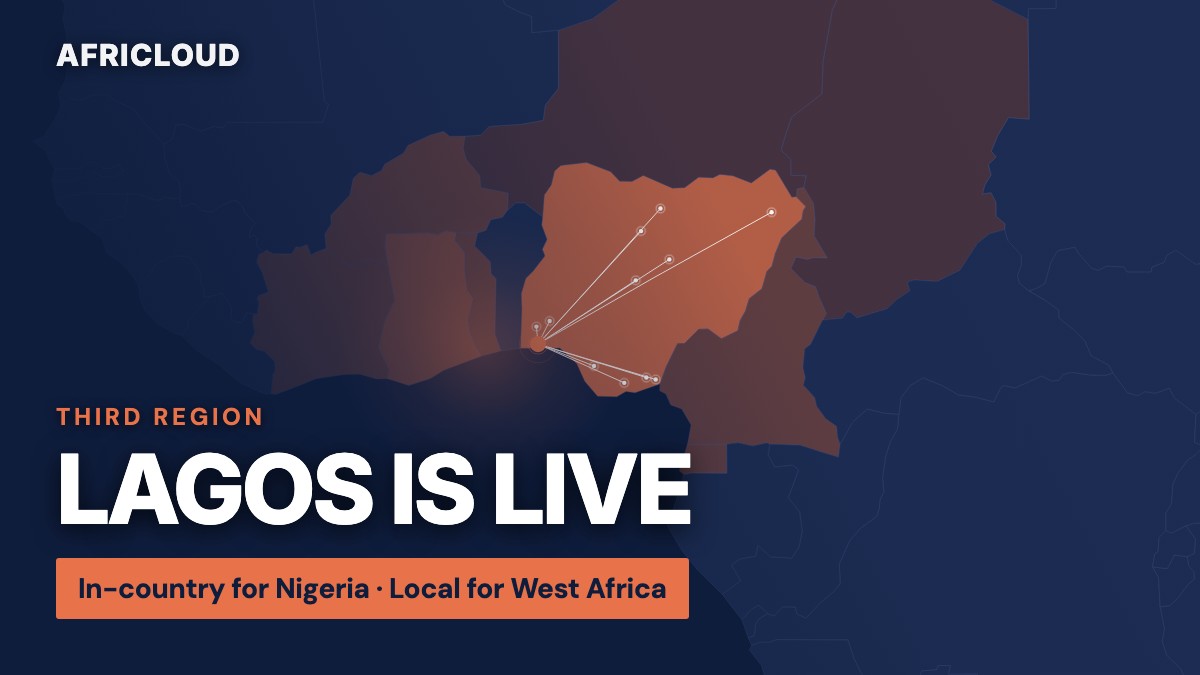
AFRICLOUD runs three regions: Lisbon, Johannesburg and Lagos, which gives you a choice of three jurisdictions on one account: Portugal under EU law, South Africa, or Nigeria. The Lagos region is in-country compute, not a network point of presence, and it peers directly at IXPN.
Criterion 2: how you pay
This is the criterion most comparison articles skip, and for a Nigerian business it is often the one that decides the outcome.
A dollar-denominated cloud bill is an unhedged currency exposure that arrives monthly. Worse, paying it at all can be the problem: a domestic naira card frequently cannot complete an international card transaction, which leaves finance teams improvising with someone's personal card or a domiciliary account.
Our answer is that you can pay in your local currency across 21 African markets, Nigeria included, by local card, bank transfer, USSD or mobile money depending on the corridor, and that the same applies to topping up your account balance rather than only to new orders. No international card is needed. You can also pay by card, PayPal or with any of 300+ cryptocurrencies; about a quarter of all completed transactions on our platform settle in crypto (the accepted coins and the process are documented at pay with crypto), so it is a mainstream rail here rather than a novelty. Prices are shown and invoiced in naira.
Criterion 3: what you actually need from a cloud
Be precise about what you consume, because this is where the real switching cost lives. If your application is built on proprietary managed services, serverless functions, a managed NoSQL database, a managed data warehouse or a managed ML platform, those have no drop-in equivalent on a simpler provider, and the migration is a rewrite rather than a move.
If, on the other hand, you are running virtual machines, containers and a relational database, you are consuming compute and storage with extra steps. That is portable.
What you get on our side is deliberately conventional: AMD EPYC processors, enterprise NVMe storage, full root access on every plan, IPv4 and IPv6, snapshots and optional daily backups, block-storage volumes, floating IPs, private networking, a platform-level firewall beneath the guest OS, and a browser console for when you lock yourself out. There is a public REST API with scoped keys, documented at africloud.com/docs, and it works with Terraform and Ansible. Servers are self-managed: you get root and the machine, and what runs on it is yours.
Criterion 4: what it costs, and what surprises you
The headline rate matters less than the shape of the bill. Hyperscaler invoices surprise people because several meters run at once, and the one that usually does the damage is egress. If you serve images, video or backups to Nigerian users, you are paying per gigabyte to leave the data centre, every month, at a rate that does not fall as your audience grows.
Our plans run from VM1 at 1 vCPU and 1 GB RAM to VM8 at 8 vCPU and 16 GB, $20 to $320 a month, halved on every renewal with the code 50NEW. Each includes a transfer allowance from 1 TB to 8 TB by plan. That allowance is a soft cap rather than a bill: pass it and the port is reduced to 8 Mbps for the rest of the billing period, with no hard block and no overage charge. There is no setup fee, and a server is online in about two minutes from payment confirmation, with no ticket queue.
The four shapes, and which one you need
Nigerian buyers are usually choosing between four categories that are not interchangeable, and comparing them on price alone produces bad decisions.
- A hyperscaler region. The widest catalogue of managed services by a distance. Nearest capacity to Nigeria is elsewhere on the continent or in Europe, billing is in dollars, and support escalates abroad. Right when the managed services are the reason you are there.
- An in-country cloud. Compute and storage physically in Nigeria, local-currency payment, and a short answer to residency questions. Smaller service catalogues than a hyperscaler. Right for applications serving Nigerian users, and for data you would rather keep in-country.
- A local VPS or shared host. Cheapest, simplest, entirely adequate for a company website or a small application. Not an AWS replacement, and it does not pretend to be.
- Colocation or private cloud. You bring the hardware or lease a cage. Highest control, highest commitment, right for regulated workloads at scale with a team to run them.
We are in the second category. If your honest need is the third, a simpler host will serve you better and cost less.
Where AWS still wins
Plainly: in several places, and pretending otherwise would make the rest of this article worth less.
If your architecture is event-driven and bound to proprietary triggers, queues and managed databases, the migration cost is high and probably not worth paying. If you need multi-region failover with health-check-driven DNS steering, that is hard to reproduce. If you need GPU fleets, or spiky ephemeral capacity you can abandon at will, the economics are still theirs. And if your team's expertise and infrastructure-as-code tooling are already hyperscaler-shaped, switching has a real cognitive cost that no feature table shows.
A simpler cloud is a different shape, not a cheaper clone: more predictable, closer to your users, easier to reason about, and thinner on managed services. For a Django or Node.js backend serving Nigerian users, a containerised SaaS deployment, a database, a VPN or a trading VPS, that shape usually wins. For a globally distributed event-driven system, it does not.
Three checks before you move anything
- Measure your real latency, do not estimate it. Use the AFRICLOUD Looking Glass to test from our Lagos, Johannesburg and Lisbon regions to your users' networks, and compare against your current region. Nigerian networks are where the difference shows up: from Lagos we measure about 0.2 ms within the city, 1.4 ms to Ibadan, 9.9 ms to Abuja and 18.9 ms to Kano.
- Pull three months of egress charges. Model the same traffic against a plan with an included allowance. If you are spending more on bandwidth than on compute, the arithmetic will make the decision for you.
- List every managed service you actually use. Not the ones you have enabled: the ones in the critical path. For each, decide whether a self-hosted or separately managed equivalent exists. That list is your migration scope, and it is usually shorter or far longer than people expect.
If the answer is a split, that is the normal outcome, not a failure. Move what serves Nigerian users to Nigeria, keep what genuinely needs a hyperscaler where it is, and stop paying international transfer costs for traffic that never should have left the country.